
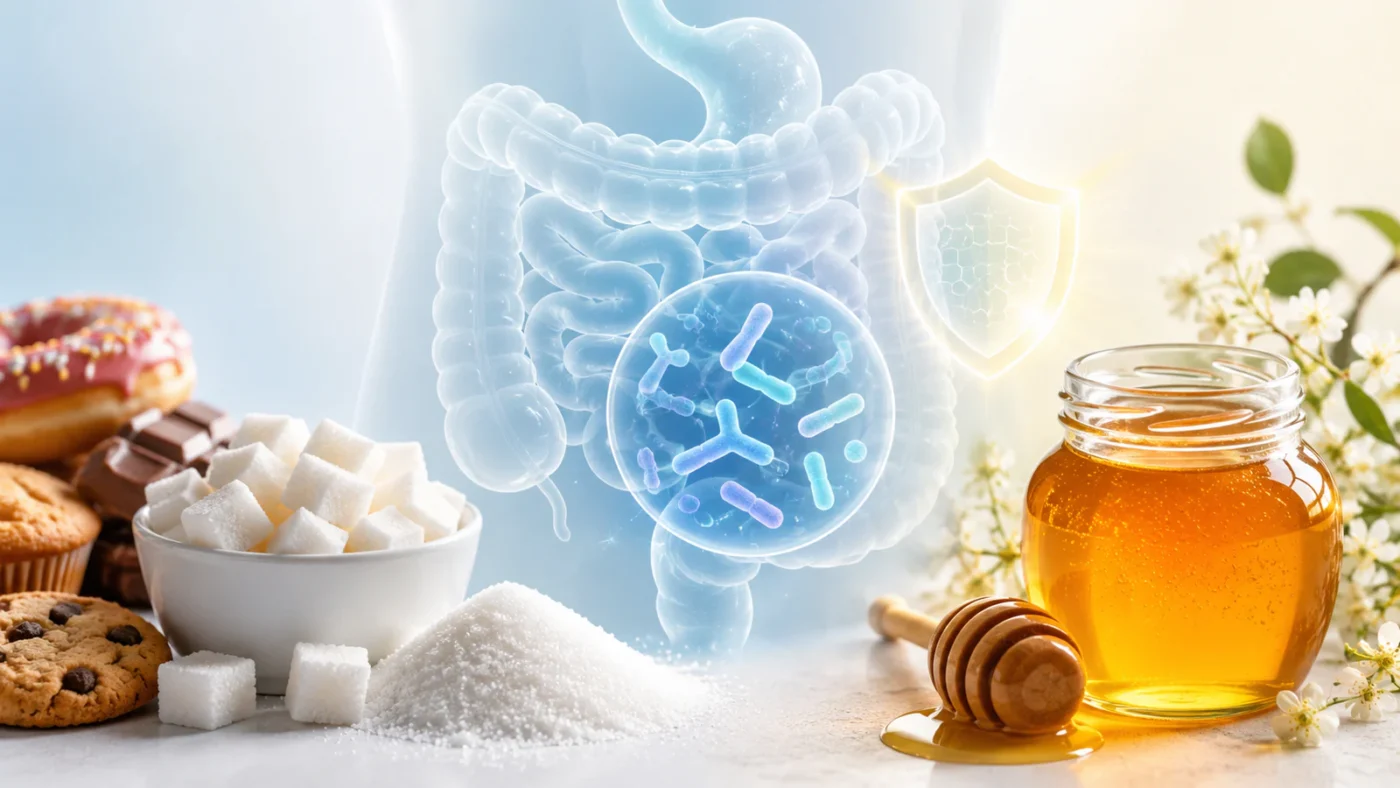
Sugar, gut health, and the microbiome are now part of the same conversation.
For years, many people thought about sugar mainly in terms of calories, weight, cavities, or blood sugar.
Today, researchers are looking deeper. They are studying how added sugar may affect gut bacteria, inflammation, immune balance, and the way the body responds to everyday challenges.
This matters because many families notice the same pattern: more tiredness, more seasonal discomfort, more colds, more allergies, and a general feeling that the body is less resilient.
However, the answer is not simple.
Research does not prove that sugar directly causes colds or allergies. It also does not prove that honey prevents them.
Still, the science around sugar, gut health, the microbiome, and immune regulation is becoming harder to ignore.
First: this is not a medical claim
Colds, allergies, asthma, immune weakness, and inflammation are complex topics.
They can involve genetics, environment, sleep, stress, air quality, infections, medications, diet, and many other factors.
Therefore, it would be wrong to say that sugar alone causes immune problems.
It would also be wrong to say that honey cures, treats, or prevents them.
The better question is more practical:
Can everyday food choices influence the gut environment that helps regulate immune balance?
Research suggests that this question is worth asking.
Sugar, gut health, and the microbiome: the simple connection
The gut microbiome is the community of bacteria and other microorganisms living in the digestive tract.
These microorganisms are not just passive passengers. They interact with digestion, the gut barrier, inflammation, and immune signaling.
For this reason, researchers now study the gut microbiome as part of the body’s wider defense system.
A review on high sugar intake reported that excessive sugar consumption may shift the gut microbiome toward a more pro-inflammatory balance.[1]
More recently, a 2025 review summarized evidence that added sugars can affect gut microbiota diversity and composition. The authors also discussed possible mechanisms linking sugar-related microbial changes to broader health outcomes.[2]
In practical terms, this means that sugar is not only a “sweetness” issue.
It may also be a gut-environment issue.
1. Sugar and immune balance
The immune system does not work in isolation.
A large part of immune activity communicates with the gut, the intestinal barrier, and the microorganisms living there.
When the gut environment becomes less balanced, researchers often describe this as dysbiosis.
Dysbiosis does not automatically mean disease. However, it can be associated with more inflammation, weaker barrier function, and less balanced immune signaling.
One study reported that a high-sugar diet disrupted microbiota-dependent immune protection in an animal model.[3]
Another animal study found that diets high in simple sugars changed gut microbial ecology and worsened colitis in mice.[4]
These are not direct human claims. They do not prove that sugar causes the same effects in every person.
However, they support a broader concern:
Repeated exposure to added sugar may affect the gut environment that helps regulate immune balance.
2. Gut health, colds, and everyday resilience
People often talk about “low immune defenses” in everyday language.
They may mean that they get sick more often, recover more slowly, or feel less resilient during cold season.
Science uses more specific language. Researchers study immune signaling, gut barrier function, inflammation, microbiota diversity, and the relationship between gut bacteria and respiratory infections.
Reviews on the microbiome and respiratory infections describe how microbial communities can interact with immune responses during infection.[5]
This does not mean that a sweet snack causes a cold.
Viruses cause common colds.
Still, the body’s immune response depends on many systems, and the gut microbiome is one of the systems researchers continue to study.
For families, the practical point is simple:
If the goal is everyday resilience, food quality matters.
3. Gut health and allergies
Allergies are also complex.
They involve immune regulation, environmental exposure, genetics, the skin barrier, the respiratory system, and the gut.
A 2025 review on early-life microbiota and allergic disorders reported that the gut microbiota plays an important role in regulating immune responses related to allergic disease development.[6]
Again, this does not prove that sugar directly causes allergies.
It also does not prove that honey prevents allergies.
However, it does support the idea that the gut microbiome matters for immune balance.
That is why the conversation around snacks, sugar, gut health, and allergies is becoming more relevant for parents and health-conscious families.
Why added sugar is different from a naturally complex food
Added sugar is usually a simple, refined ingredient.
Food manufacturers use it because it is cheap, predictable, and easy to process.
Glucose syrup and corn syrup work in a similar way. They help control sweetness, texture, crystallization, and shelf stability.
However, these ingredients do not bring much natural complexity to the food.
By contrast, some traditional foods contain sugars together with other compounds.
Honey is one example.
Honey still contains sugar. It should not be described as sugar-free, and people who monitor blood sugar should read nutrition facts carefully.
Nevertheless, honey is not just refined sugar in liquid form.
It contains sugars, but also small amounts of organic acids, enzymes, phenolic compounds, flavonoids, minerals, and non-digestible carbohydrates such as oligosaccharides.
This is why researchers study honey differently from refined sugar.
Why honey is being studied as a prebiotic food
A prebiotic is a food component that can support favorable changes in the gut microbiota.
Honey has become interesting to researchers because some types of honey contain non-digestible carbohydrates, including oligosaccharides.
These compounds can reach the lower intestine, where they may interact with gut bacteria.
A 2022 review described the current evidence on honey’s prebiotic potential. The authors reported that certain types of honey may help regulate gut microbial communities, stimulate beneficial species such as Lactobacillus and Bifidobacteria, and reduce the presence of some infection-causing bacteria in experimental settings.[7]
This is promising, but it is not a cure.
The same review also made clear that more research is needed, especially in humans.
Therefore, the responsible conclusion is this:
Honey is being studied as a prebiotic food, but it should not be marketed as a treatment for immune problems, colds, or allergies.
Honey, inflammation, and immune signaling
Researchers have also studied honey for its anti-inflammatory and immunomodulatory properties.
A review on honey and inflammation discussed compounds such as polyphenols and their possible role in inflammatory pathways.[8]
Another review on honey and gut microbial balance described honey’s potential prebiotic effects, especially in relation to beneficial bacteria.[9]
These findings are useful as educational context.
They do not mean that honey automatically “boosts the immune system” in every person.
They also do not mean that a honey-based snack can prevent illness.
However, they help explain why honey is different from refined sugar as an ingredient.
What this means for everyday snack choices
Most sweet snacks are built around refined sugar, glucose syrup, corn syrup, or other industrial sweeteners.
These ingredients make production easier and cheaper.
However, families are increasingly asking better questions:
- What is this snack sweetened with?
- Does it contain refined sugar?
- Does it contain glucose syrup?
- Does it contain corn syrup?
- Is it made with recognizable ingredients?
- Does it fit the way we want to eat every day?
For more context on sweeteners, read our guide to honey vs refined sugar.
This does not mean every sweet food is bad.
Rather, it means the source of sweetness matters.
A snack made with refined sugar or industrial syrups is not the same as a snack made with traditional ingredients such as honey and nuts.
Where AmoreZero fits into this conversation
AmoreZero is a soft Italian snack inspired by traditional torrone. It is made with raw honey and roasted almonds, without refined sugar, glucose syrup, or corn syrup.
This does not make AmoreZero a medical food.
It does not mean AmoreZero prevents colds, treats allergies, strengthens immune defenses, or cures gut problems.
That is not the claim.
The difference is simpler and more practical:
AmoreZero gives people a sweet snack option made without refined sugar, glucose syrup, or corn syrup.
For parents choosing lunchbox snacks, workers looking for an office break, active people wanting a satisfying bite, or anyone trying to avoid industrial sweeteners, that ingredient choice can matter.
People looking for better snacks are not always looking for perfection.
Often, they are simply looking for fewer industrial shortcuts.
Sugar, gut health, and the microbiome: the bottom line
Research does not prove that sugar directly causes colds or allergies.
It also does not prove that honey prevents illness.
However, research does show several separate things worth knowing:
- High sugar intake may shift the gut microbiome toward a more pro-inflammatory balance.
- The gut microbiome interacts with immune regulation and the gut barrier.
- Gut microbiota has been studied in relation to respiratory infections and allergic diseases.
- Honey contains oligosaccharides and is being studied for prebiotic potential.
- Honey is different from refined sugar, but it still contains natural sugars.
For families, the responsible conclusion is simple:
Everyday snack quality matters.
When choosing a sweet snack, the question is not only:
Does it taste good?
The better question is:
What is this snack made with?
References
[1] Satokari R. “High Intake of Sugar and the Balance between Pro- and Anti-Inflammatory Gut Bacteria.” Nutrients. 2020. PubMed
[2] Zhang Y et al. “Added sugars, gut microbiota, and host health.” 2025. PubMed
[3] Kawano Y et al. “Microbiota imbalance induced by dietary sugar disrupts immune-mediated protection from metabolic syndrome.” Cell. 2022. PubMed
[4] Khan S et al. “Dietary simple sugars alter microbial ecology in the gut and promote colitis in mice.” Science Translational Medicine. 2020. PubMed
[5] Marrella V et al. “Microbiota and Immunity during Respiratory Infections.” 2024. PMC
[6] Dera N et al. “Impact of Early-Life Microbiota on Immune System Development and Allergic Disorders.” 2025. PubMed
[7] Schell KR et al. “The Potential of Honey as a Prebiotic Food to Re-engineer the Gut Microbiome Toward a Healthy State.” Frontiers in Nutrition. 2022. PubMed
[8] Ranneh Y et al. “Honey and its nutritional and anti-inflammatory value.” BMC Complementary Medicine and Therapies. 2021. PMC
[9] Mohan A et al. “Effect of honey in improving the gut microbial balance.” Food Quality and Safety. 2017. Oxford Academic